This ones got me stumped

jason2000ls

Active LVC Member
Joined
Apr 30, 2012
Messages
57
Reaction score
0
Location
manitoba
So reciently I had an issue with the car . Check engine light came back on . Scanned it and it was failing cats (on both sides) . I went to the local exhaust shop and had em gutted out, and had o2 delete kit installed (basically anti foulers) they cleared the code. 150 miles later check engine light on again. Cat codes again, at this point I figured it was inevitable. So i decided I would live with it .. On the way to work today I had to make a stop for gas, And regular was all that was available so I filled it up .. Not 15 minutes later check engine light off and car runs way better . What's wrong here as I'd like to resolve this and run premium again
 
Since the HO2S deletes on the CATs, did they reset the KAM ?

Perhaps try disconnecting both battery terminals for 15 minutes, reconnect, drive.
Anytime sensors are replaced, clearing codes and resetting is never a bad idea.


ABSTRACT:
... up to six driving cycles may be required to illuminate the MIL during normal customer driving.
If KAM is reset, a malfunction will illuminate the MIL in 2 drive cycles.
 
2001 PCED
OBD II


Catalyst Efficiency Monitor - Federal Test Procedure

The Catalyst Efficiency Monitor uses an oxygen sensor before and after the catalyst to infer the hydrocarbon efficiency based on oxygen storage capacity of the catalyst. Under normal, close-loop fuel conditions, high efficiency catalysts have significant oxygen storage. This makes the switching frequency of the rear heated oxygen sensor (HO2S) very slow and reduces the amplitude of those switches as compared to the switching frequency and amplitude of the front HO2S. As the catalyst efficiency deteriorates, its ability to store oxygen declines. The post-catalyst or downstream HO2S signal begins to switch more rapidly with increasing amplitude, approaching the switching frequency and amplitude of the pre-catalyst or upstream HO2S.

All applications utilize an FTP-based (Federal Test Procedure) catalyst monitor. This simply means that the catalyst monitor must run during a standard FTP emission test as opposed to the 20-second steady state catalyst monitor used in 1994 through some 1996 vehicles. Two slightly different versions of the catalyst monitor are used in the 2001 model year


Switch Ratio Method (1996 - 2001)

  1. In order to assess catalyst oxygen storage, the monitor counts front and rear HO2S switches during part-throttle, close-loop fuel condition after the engine is warmed-up and inferred catalyst temperature is within limits. Front switches are accumulated in up to nine different air mass regions or cells although three air mass regions is typical. Rear switches are counted in a single cell for all air mass regions. When the required number of front switches has accumulated in each cell, the total number of rear switches is divided by the total number of front switches to compute a switch ratio. A switch ratio near 0.0 indicates high oxygen storage capacity, hence high HC efficiency. A switch ratio near 1.0 indicates low oxygen storage capacity, hence low HC efficiency. If the actual switch ratio exceeds a calibrated threshold switch ratio, the catalyst is considered failed.

    Inputs from ECT or CHT (warm engine), IAT (not extreme ambient temperatures), MAF (greater than minimum engine load), VSS (within vehicle speed widow) and TP (at part-throttle) are required to enable the Catalyst Efficiency Monitor.


    [*]The DTCs associated with this test are DTC P0420 (Bank 1) and P0430 (Bank 2). Because an Exponentially Weight Moving Average algorithm is use for malfunction determination, up to six driving cycles may be required to illuminate the MIL during normal customer driving. If KAM is reset, a malfunction will illuminate the MIL in 2 drive cycles


Index Ratio Method (some 2001 and beyond)

  1. In order to assess catalyst oxygen storage, the catalyst monitor counts front HO2S switches during part-throttle, closed-loop fuel conditions after the engine is warmed-up and inferred catalyst temperature is within limits. Front switches are accumulated in up to three different air mass regions or cells. While catalyst monitoring entry conditions are being met, the front and rear HO2S signal lengths are continually being calculated. When the required number of front switches has accumulated in each cell, the total signal length of the rear HO2S is divided by the total signal length of the front HO2S to compute a catalyst index ratio. An index ratio near 0.0 indicates high oxygen storage capacity, hence high efficiency. A switch ratio near 1.0 indicates low oxygen storage capacity, hence low HC efficiency. If the actual index ratio exceeds the threshold index ratio, the catalyst is considered failed.

    Inputs from ECT or CHT (warm engine), IAT (not extreme ambient temperatures), MAF (greater than minimum engine load), VSS (within vehicle speed widow) and TP (at part-throttle) are required to enable the Catalyst Efficiency Monitor.


    [*]The DTCs associated with this test are DTC P0420 (Bank 1) and P0430 (Bank 2). Because an Exponentially Weighted Moving Average algorithm is use for malfunction determination, up to six driving cycles may be required to illuminate the MIL during normal customer driving. If KAM is reset, a malfunction will illuminate the MIL in 2 drive cycles


If the catalyst monitor does not complete during a particular driving cycle, the already accumulated switch/signal data is retained in Keep Alive Memory and is used during the next driving cycle to allow the catalyst monitor a better opportunity to complete.

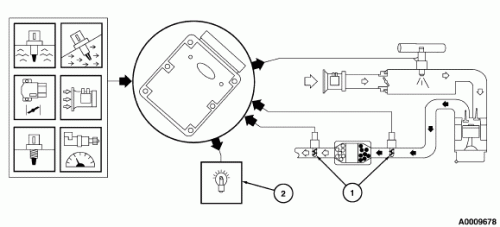
v12~us~en~file=a0009678.gif~gen~ref.gif


~ in other words, Just keep driving!

v12~us~en~file=a0009678.gif~gen~ref.gif
 

Members online

No members online now.
Back
Top